

When we say somebody is psychotic, we usually mean they have delusions or hallucinations. They could also have disorganized thoughts, as in nonsensical and jumbled speech, or disorganized behavior, as in pointless and repetitive gestures. Being psychotic is most associated with schizophrenia, because that’s how our manuals present it. The DSM and ICD describe psychotic symptoms only in relation to schizophrenia and similar disorders, implying that one is a “reasonable proxy” for the other.
This doesn’t make sense, because psychosis shows up all over. It’s standard in mania and unremarkable in depression. Delusions, hallucinations, and disorganization are common in the sudden confusion of delirium and the slow degeneration of dementia, each with countless causes of their own. Psychosis occurs with methamphetamine, cannabis, and corticosteroids, not to mention traumatic brain injury, lupus, congenital conditions, cancer, and the post-partum period. All of these can look similar; it’s hard to distinguish schizophrenia from mania from meth without context. The DSM and ICD recognize other causes but still privilege schizophrenia as the primary psychotic disorder.
Psychosis doesn’t just occur in other diagnoses; it’s a sign they’re getting worse. In mania and depression, the symptoms are a “severity index.” Delusions and hallucinations correlate to more severe delirium, while their onset in dementia is “inextricably linked to cognitive decline.” For medical causes, resolving psychosis tracks treatment of the condition. Even schizophrenia has a pre-psychotic phase, and we interpret psychotic episodes as exacerbations. In most situations, psychotic symptoms lag behind and denote advancing illness.
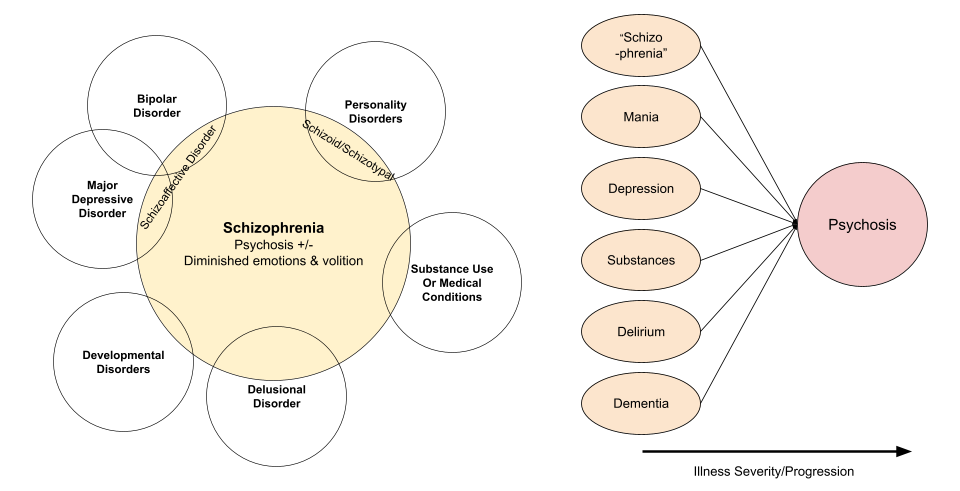
It’s more consistent to say that psychosis is a result of all these conditions. We agree it’s a consequence of cannabis abuse and auto-immune encephalitis; why call it something else in mania or schizophrenia? In fact, some scholars have likened psychosis to fever as a generic marker of serious mental illness. Fever isn’t an aspect of bacterial pneumonia or rheumatoid arthritis, it’s a sign that something’s wrong. But it’s also a single finding, and a protective response, whereas psychosis is a group of symptoms that are hard to see as adaptive.
These symptoms are more than unhelpful, they’re evidence the brain isn’t doing its job. This is something like relating the organism to its environment, enabling adaptive behavior, or interpreting and responding to the world. Failure here matches classic takes on psychosis as impaired reality-testing or reduced “capacity to deal with reality.” If your brain isn’t working, faulty interpretations and illogical actions occur. If your kidneys aren’t working, excess fluid and waste build up. If your heart isn’t working, blood flow goes down. Anytime an organ can’t perform its chief function, we call it organ failure. The brain is an organ, and psychosis is a type of brain failure.
Compared to the brain, other organs have well-defined inputs and outputs. The kidneys make urine, and the heart turns low-pressure blood into high-pressure blood. On some level the brain processes information, on another it takes in perception and puts out action. Behavior and thought are good candidates for “brain output,” although they’re hard to measure. This isn’t disqualifying; liver failure is diagnosed indirectly by mental changes and slowed blood clotting. Psychotic brain failure could one day be defined as symptoms plus a biomarker like certain EEG findings. Progress here requires changing focus from diagnoses like schizophrenia to the physiological states of psychosis.
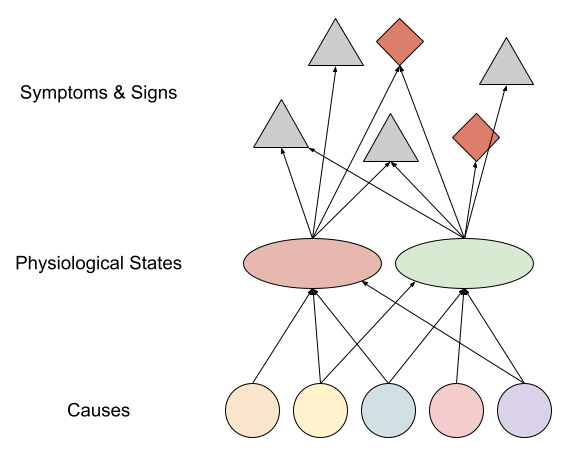
Like every organ, the brain fails in more than one way. Heart failure can be low-output or high-output; right-sided, left-sided, or both; with heart muscle that’s too flaccid or too stiff. Abnormal heart rate, slow or fast, also drops cardiac performance. With psychosis, some people only have delusions or hallucinations while others are disorganized; some do too much while others do too little.1 And altered consciousness is its own type of brain failure. Coma and vegetative states are persistent unawareness, delirium is fluctuating arousal and confusion, and the dementias can take their own path to absent awareness. This is a two-way street; delirium and dementia cause psychosis like abnormal heart rhythm and abnormal heart contraction feed off each other.
Notably, disorders of consciousness, delirium, and dementia have all been characterized as brain failure before. Physicians don’t have a problem with the idea of brain failure, we just exclude mental illness. Would patients have a problem with brain failure? It doesn’t sound good; this is presumably why we say delirium and dementia instead.2 Of course, psychosis and schizophrenia are hardly baggage-free. They’ve replaced madness, insanity, and lunacy on the euphemism treadmill, but the problem is the illness, not the terminology. Epileptic, consumptive, and leper were all stigmatized identities too, and the solution was better treatment out of better understanding.
And this medical framing does change how we think about a lot of disorders. If psychosis is “brain failure with intact consciousness,” it stands alone.3 The DSM and ICD should classify it as such, just like heart failure has its own set of codes apart from cardiomyopathies and valve defects. This means that schizophrenia can’t be defined by psychosis. Instead, as others have said, it’s a group of conditions marked by poor motivation, flat emotions, social withdrawal, and cognitive decline. They often lead to brain failure in the same way that cardiomyopathies often lead to heart failure. In addition, specifiers like “Major Depressive Disorder, recurrent, severe, with psychotic features” become unnecessary, as do kludges like schizophreniform and schizoaffective disorder.
In our rush to adopt the medical model, we forgot one of its most basic concepts. Psychosis is brain failure: a non-specific syndrome, a consequence of advancing illness, and a breakdown in basic brain function. Elevating psychosis to organ failure gives it equal status to heart, kidney, and liver failure, all as serious as illness gets. It also encourages work on physiological types and subtypes of psychosis. This isn’t academic; acute heart failure gets the opposite treatment depending on whether the lungs are wet or dry. Someday psychosis will also have different and more effective medications for different classifications.
Delirium and dementia don’t work that well as acute and chronic brain failure. For one, they’re not short and long-term versions of the same thing. The epidemiology is also off. It doesn’t make sense that chronic brain failure only occurs in the elderly while heart, kidney, lung, and liver failure happen in plenty of young people. Psychosis is a better fit.
Interesting read and one I find myself in many ways aligned with, in particular the idea that schizophrenia is not synonymous with psychosis.
I hesitate with the idea of 'brain failure' itself though. In organ failure, the hardware is genuinely broken. But in most psychosis, the brain seems to be running, just in a mis-calibrated way at the level of various networks/processes. For example, with aberrant salience, the salience process isn't necessarily 'broken' at a hardware level (even if there are correlates of that miscalibration) - it's just mis-calibrated (and can be re-calibrated).
The cause of that mis-calibration, are not necessarily just due to the brain malfunctioning either (i.e. trauma is gonna lead to excessive salience on trauma related percepts, and potentially lead to 'psychotic' symptoms - the brain isn't failing here and wasn't the primary source of the psychotic symptom?).
I think psychosis broadly represents a breakdown in the alignment between a person's internal model of reality and the shared reality they inhabit. Most psychiatric disorders involve some version of that drift: depression, anxiety, trauma etc all involve internal models that have diverged from 'the norm' resulting in dysfunction within a shared world. When that misalignment increases, with severity of illness - it makes sense that one might develop psychotic symptoms, as the internal models begin to influence even perception. It's no wonder that, psychotic symptoms in mood disorder - are often mood congruent. They related to the extent of the misalignment, and not necessarily to a broken physical process.
This also links to your footnote on subclinical psychotic experiences. If it's a continuum of self-world misalignment, it's unsurprising that such experiences are common. Most people drift a little, some more, a few - enough that dysfunction arises and we call it a disorder.
Why is delirium not acute brain failure it fits it perfectly?