

When they show up for an evaluation, patients want an explanation that fits their experience.1 This may not be a diagnosis, however. If needed, a diagnosis should be accurate enough to guide treatment and stable enough not to change every other visit. This doesn’t always happen.
A diagnosis is a label, but diagnosis is a process. Lean is a system for improving processes by reducing waste and variation. How would Lean approach psychiatric diagnosis?
Define the Process
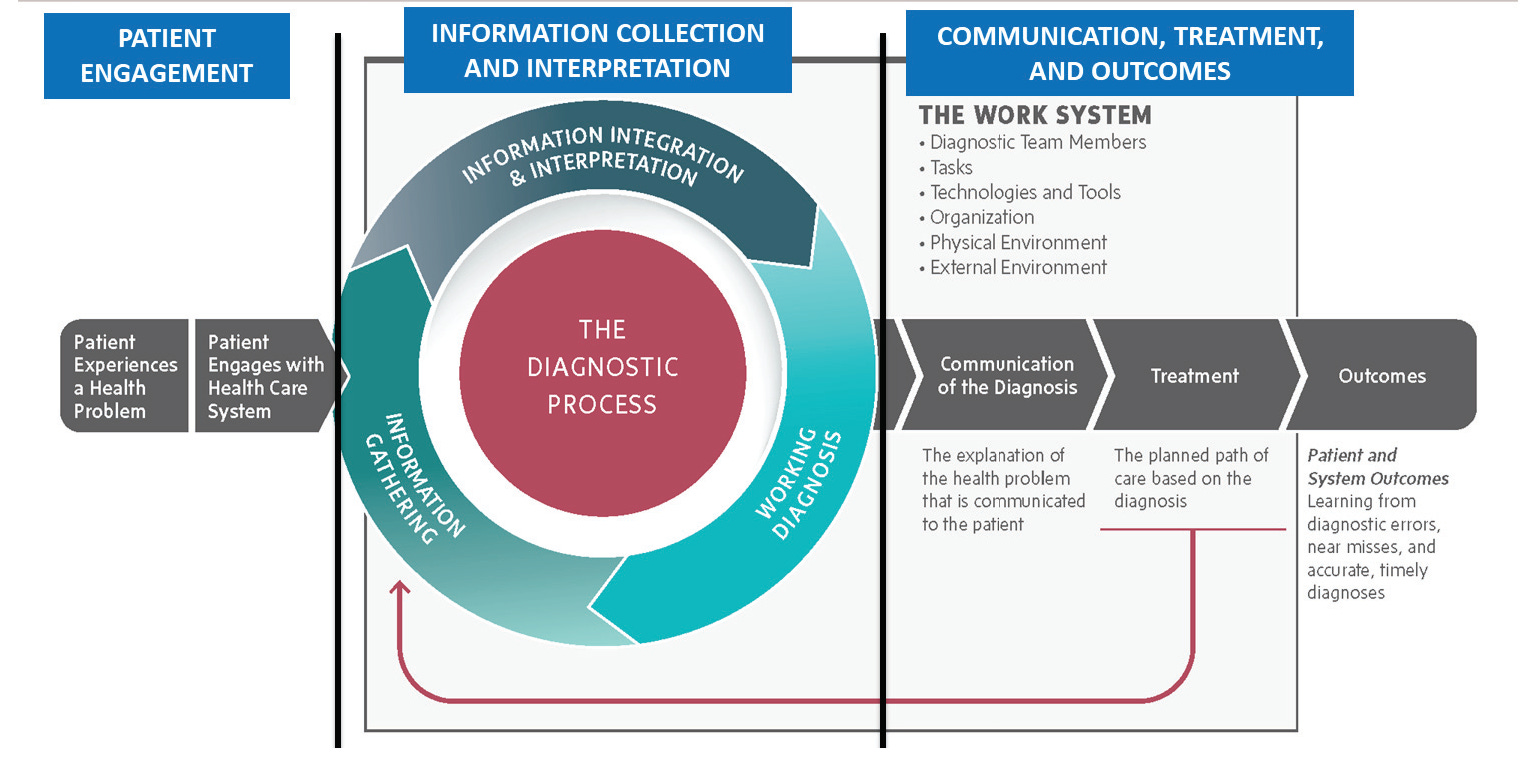
The supplier is the patient, and their input is information. The process is cycles of differential diagnosis, questions and answers, observation, interpretation, a new differential, repeat as needed. Instead of transforming objects, the work is reducing uncertainty. The number of potential diagnoses should dwindle, ideally to a single output: a diagnostic label. It goes to the immediate customer, a treatment plan, with the patient as the ultimate customer.
Eliminate Waste
Every part of a process that doesn’t add value is waste. In healthcare, that’s a patient moving room to room, a patient waiting on the doctor, a nurse trudging off for supplies, a medication error, a note no one reads. What counts as waste in the diagnostic process?
A label that doesn’t benefit the patient or hold up to scrutiny is a defect. They result from poor design as well as errors like unasked questions, misinterpreted responses, or premature cognitive closure. For example, the provider takes a mention of panic attacks at face value, leading to an unreliable label and unnecessary medication. Defects require rework, like a second or third opinion, to fix.
When the product wasn’t wanted or needed, that’s overproduction. Giving everybody a diagnosis because they happen to “meet the criteria” pushes a label on customers seeking a different explanation. Overproduction also occurs when clinicians list a diagnosis just for billing and when they produce multiple labels for one group of symptoms. Defaulting to generic codes for psychological distress avoids unnecessary labels and may be a better fit in many cases.
When arriving at a diagnosis takes more steps than necessary, that’s extra-processing. For instance, fatigue and poor attention are included in numerous disorders. They’re so common, in fact, that their presence doesn’t narrow down the diagnosis much. If anything, including fatigue and poor attention in the criteria creates more uncertainty than it resolves. They shouldn’t count toward most disorders.2
Reduce Variation
Despite all the checklists, procedures for diagnosis are far from standardized. Interviews vary in which questions are asked, in what order, and how they are phrased. They require judgment as to whether an experience counts as a symptom and which condition(s) it counts toward. In short, diagnosis lacks standard work.
As a result, clinicians often produce different outputs from the same patient input. The DSM 5 field trials in 2013 reported low reliability for many conditions, including major ones like MDD and GAD.
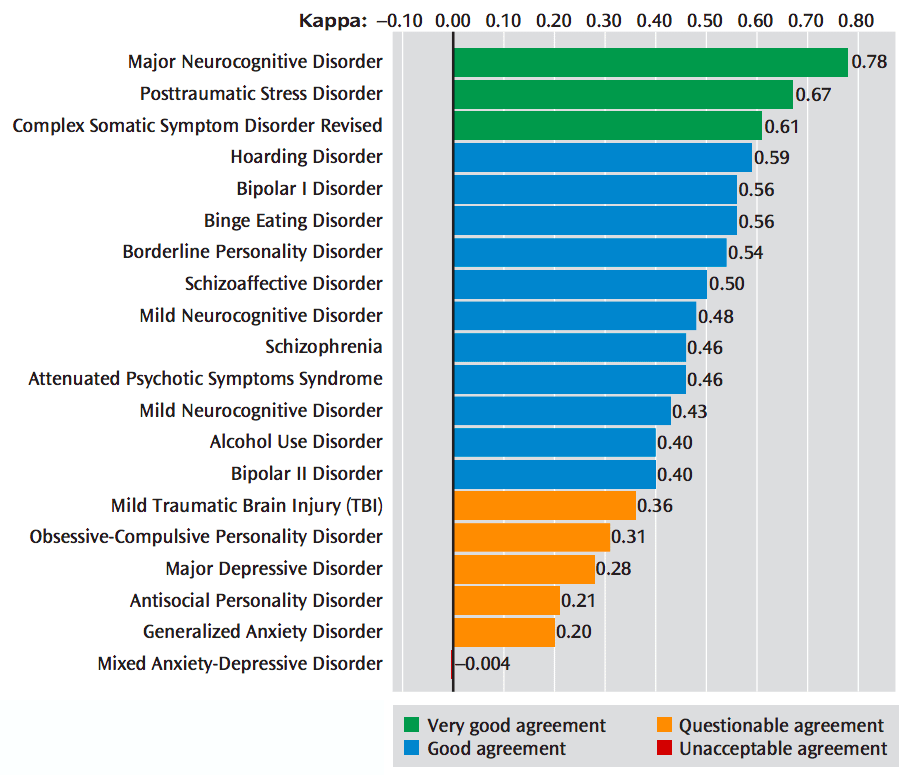
It’s common to report reliability as an attribute of individual disorders, but it’s really about the process that led there. Structured clinical interviews boost reliability by directing which questions to ask and how to ask them. Clinicians watching the same recorded interview converge even more, with reliability scores jumping from 0.47 to 0.80. Standardization helps.3
A diagnostic manual shouldn’t just describe diagnoses; it should define standard work for making them. In this context, that’s the sequence and phrasing of questions that best elicits useful information. This would reduce variation, simplify training, and set a baseline for further changes. Improvement isn’t possible without a stable process.
Look for root causes
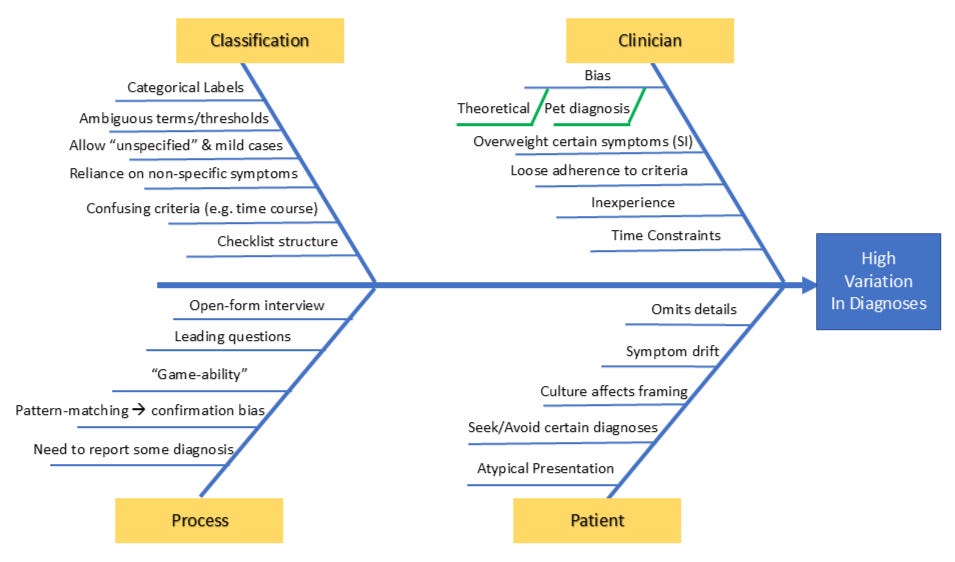
The way disorders are classified is one source of variation, but patient, process, and worker factors matter too. The architects of DSM-III acknowledged other aspects but focused their effort on operationalizing individual diagnoses. Outcomes like low reliability always have multiple causes, and Fishbone diagrams are the standard way to think through possibilities:
“Five Why’s” is another method for root cause analysis. It starts with an unwanted result, then asks why:
A patient received two different diagnoses.
Why?
The clinicians came to different conclusions.
Why?
They disagreed whether the patient had Generalized Anxiety Disorder.
Why?
They disagreed whether the patient’s “worry” was excessive.
Why?
They relied on the patient’s self-report.
Why?
They didn’t use a validated metric for “worry.”
This exercise suggests that one cause of variation is not using standard symptom measures. If excessive worry is the core feature of Generalized Anxiety, we should use tools that assess worry itself before making a diagnosis. This makes more sense than a questionnaire to assess an entire disorder, and it’s a better match to what the rest of medicine does.
Continuous Improvement
We can’t know if things are improving unless we constantly measure how things are going. In the U.S., the APA should establish reliability surveillance for major diagnoses. This would look like small scale DSM field trials, rotating across multiple sites, to track outcomes and to gather ideas for improvement from people doing the work. Changes like those suggested above must be tried in practice, kept or discarded, and iterated again.

The process of diagnosis is cognitive rather than physical, but it can still be measured, standardized, and improved. The goals are modest: less time to a reliable diagnosis, fewer errors, a faster route to helpful treatment. While the clinic will never be an assembly line, removing waste and reducing variation go a long way. These are basic ideas in quality improvement, but they’re not ones we’ve seriously tried.
Also desirable: being listened to, acknowledged, and involved in decisions.
Common but vague symptoms can add information in their absence, by ruling out diagnoses. The best example is fever, which is sensitive but not specific for many infectious and auto-immune conditions. Lack of fever argues against pneumonia, for instance, but presence of fever can’t rule in a specific diagnosis. The DSM and ICD get this backward.
An interesting fact about standardization is that it works for every industry and process except yours (!), which requires unique skill and discernment.